JavaScript – The Number Object
In JavaScript, the Number object is a built-in object that provides methods and properties for working with numeric values. It represents both integer and floating-point numbers and allows you to perform various operations on them.
Understanding the Number Object
In JavaScript, the Number object is a global object that represents numerical values. It is important to distinguish between primitive number values and the Number object. Primitive number values are represented directly as numbers, whereas the Number object is a wrapper around primitive number values, providing additional functionality.
Let’s start by exploring some basic features of the Number object.
Creating Number Objects
You can create a Number object using its constructor:
let num = new Number(42);Code language: JavaScript (javascript)However, in most cases, you won’t need to create Number objects explicitly, as JavaScript automatically converts primitive numbers to Number objects when needed.
Number Properties
The Number object has several useful properties:
Number.MAX_VALUE: Represents the largest positive finite number that can be represented in JavaScript.Number.MIN_VALUE: Represents the smallest positive finite number.Number.POSITIVE_INFINITY: Represents positive infinity.Number.NEGATIVE_INFINITY: Represents negative infinity.Number.NaN: Represents “Not-a-Number,” a special value used to indicate an unrepresentable value.
Number Methods
The Number object provides various methods for working with numeric values:
toFixed(): Formats a number with a specified number of decimal places.toPrecision(): Formats a number with a specified total number of digits.toString(): Converts a number to a string.parseInt(): Parses a string and returns an integer.parseFloat(): Parses a string and returns a floating-point number.isFinite(): Checks if a value is a finite number.isNaN(): Checks if a value is NaN.
Practical Applications
Now that we’ve covered the basics of the Number object, let’s explore some real-world scenarios where it comes in handy.
1. Mathematical Operations
The Number object is essential for performing mathematical operations in JavaScript. Whether you’re calculating simple arithmetic expressions or complex mathematical algorithms, Number objects allow you to work with precision and control.
let x = 10;
let y = 3;
let result = new Number(x / y); // Using Number object for precision
console.log(result.toFixed(2)); // Outputs: "3.33"Code language: JavaScript (javascript)
2. Data Validation
When working with user input or external data sources, it’s crucial to validate numeric values. The isNaN() method of the Number object is a valuable tool for checking if a value is a valid number.
let userInput = "42";
if (!isNaN(userInput)) {
    let numValue = parseFloat(userInput);
    // Process the valid numeric input
} else {
    // Handle invalid input
}Code language: JavaScript (javascript)
3. Number Formatting
Formatting numbers for display is a common requirement in web development. The Number object’s toLocaleString() method can be used to format numbers according to the user’s locale, adding thousands separators and respecting regional conventions.
let number = 10000;
let formattedNumber = new Number(number).toLocaleString(); // "10,000" (in many locales)Code language: JavaScript (javascript)
4. Financial Calculations
In finance-related applications, precise handling of monetary values is critical. The Number object’s toFixed() method is often used to round and format currency amounts.
let price = 49.99;
let taxRate = 0.08;
let totalPrice = new Number(price + price * taxRate).toFixed(2); // "54.00"Code language: JavaScript (javascript)
Example :
<!DOCTYPE html>
<html>
<head>
    <title>Number Object Example</title>
</head>
<body>
    <h1>JavaScript Number Object Example</h1>

    <p id="demo"></p>

    <script>
        // Creating numeric variables
        let num1 = 42;       // An integer
        let num2 = 3.14;     // A floating-point number

        // Using Number methods
        let strNum = "123";
        let intNum = Number.parseInt(strNum); // Converts a string to an integer
        let floatNum = Number.parseFloat("3.14159"); // Converts a string to a floating-point number
        let formattedNum = floatNum.toFixed(2); // Formats a number with 2 decimal places
        let binaryString = intNum.toString(2); // Converts an integer to binary string

        // Checking for NaN
        let result = 0 / 0; // Produces NaN
        let isResultNaN = isNaN(result);

        // Displaying the results in HTML
        let demoElement = document.getElementById("demo");
        demoElement.innerHTML = `
            <p>Original Number Variables:</p>
            <p>num1: ${num1}</p>
            <p>num2: ${num2}</p>
            <hr>
            <p>Using Number Methods:</p>
            <p>parseInt("123"): ${intNum}</p>
            <p>parseFloat("3.14159"): ${floatNum}</p>
            <p>toFixed(2): ${formattedNum}</p>
            <p>toString(2): ${binaryString}</p>
            <hr>
            <p>Checking for NaN:</p>
            <p>0 / 0 is NaN: ${isResultNaN}</p>
        `;
    </script>
</body>
</html>Code language: JavaScript (javascript)
Output :
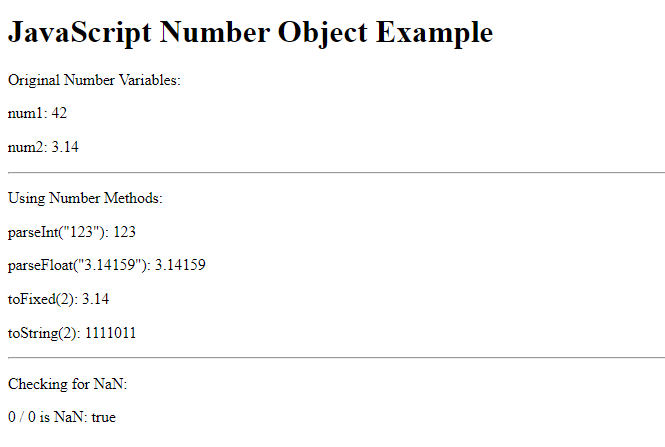
In this HTML example, we start by creating numeric variables (num1 and num2). Then, we demonstrate various Number Object methods:
- We convert a string to an integer using
parseInt(). - We convert a string to a floating-point number using
parseFloat(). - We format a floating-point number with two decimal places using
toFixed(). - We convert an integer to a binary string using
toString()with base 2.
Additionally, we show how to check if a value is NaN using isNaN() and display the results within the HTML document.
This example helps illustrate the practical usage of the JavaScript Number Object within an HTML context.
Conclusion
The Number object in JavaScript is a versatile tool for working with numeric data. Understanding its properties and methods empowers developers to perform mathematical operations, validate data, format numbers, and handle a wide range of practical scenarios effectively.
As you continue your journey in JavaScript development, remember that mastering the Number object is just one step toward becoming a proficient programmer. Practice, experimentation, and a deep understanding of JavaScript’s capabilities will help you build robust and dynamic web applications.
Related posts:
 JavaScript -Strings
Regular Expressions and RegExp Object
JavaScript – The Math Object
JavaScript – Operators
Powered by YARPP.