---
title: "useLayoutEffect Hook – React"
url: https://khanwaseem.com/blog/course/uselayouteffect-hook-react
author: "khan Waseem"
published: 2023-10-27
updated: 2023-10-27
topics: ["course", "React Tutorial"]
description: "Discover the power of useLayoutEffect in React for precise DOM synchronization. Learn its synchronous execution and practical use cases in our guide."
---

# useLayoutEffect Hook – React

Table of Contents

[Toggle](#)

- [Introduction](#introduction)[Understanding the useLayoutEffect Hook](#understanding-the-uselayouteffect-hook)
- [Core Concepts](#core-concepts)[1. Synchronous Execution](#1-synchronous-execution)
- [2. Ensuring the Latest DOM Snapshot](#2-ensuring-the-latest-dom-snapshot)
- [3. Dependency Array](#3-dependency-array)

- [Use Cases](#use-cases)[1. Precise Measurements](#1-precise-measurements)
- [2. Animations and Transitions](#2-animations-and-transitions)

- [Development Issue](#development-issue)[1. Blocking the Browser](#1-blocking-the-browser)
- [2. Not Always Necessary](#2-not-always-necessary)

- [Conclusion](#conclusion)

## Introduction

In the realm of web development, creating responsive and efficient user interfaces is paramount. React, a widely used JavaScript library for building user interfaces, offers a variety of tools and hooks to help achieve this goal. One such hook is the **useLayoutEffect **hook, which allows developers to perform actions immediately after the browser layout has been updated, ensuring synchronization between the virtual DOM and the actual DOM. we’ll explore the **`useLayoutEffect` **hook in detail, understand its use cases, and provide practical examples of how it can be harnessed to create synchronized and responsive React applications.

### Understanding the useLayoutEffect Hook

The **`useLayoutEffect` **hook in React is similar to the **`useEffect` **hook, with a key difference: it runs synchronously immediately after React has performed all DOM mutations and the browser has updated the layout. This makes it a powerful tool for tasks that require precise synchronization between the virtual DOM and the actual DOM.

### Core Concepts

#### 1. Synchronous Execution

Unlike the **`useEffect` **hook, which runs asynchronously after the browser paints, **`useLayoutEffect` **runs synchronously, blocking the browser while it executes. This synchronous behavior is crucial when precise synchronization is needed.

#### 2. Ensuring the Latest DOM Snapshot

**`useLayoutEffect` **guarantees that the DOM has been updated and provides access to the most recent DOM snapshot. This is essential for operations that depend on the current state of the DOM.

#### 3. Dependency Array

Similar to `**useEffect**`, **`useLayoutEffect` **can accept a dependency array as its second argument. When dependencies change, the hook is re-executed, ensuring the synchronization logic stays up-to-date.

### Use Cases

Let’s explore some practical use cases for the **`useLayoutEffect` **hook.

#### 1. Precise Measurements

When you need to measure DOM elements or retrieve their precise dimensions, **`useLayoutEffect` **is the ideal choice. For instance, you can measure the height and width of an element immediately after it’s updated.

```xml
import React, { useLayoutEffect, useRef, useState } from 'react';

function MeasureElement() {
  const elementRef = useRef(null);
  const [dimensions, setDimensions] = useState({ width: 0, height: 0 });

  useLayoutEffect(() => {
    const element = elementRef.current;
    if (element) {
      const { width, height } = element.getBoundingClientRect();
      setDimensions({ width, height });
    }
  }, []);

  return (
    <div ref={elementRef}>
      <p>Width: {dimensions.width}px</p>
      <p>Height: {dimensions.height}px</p>
    </div>
  );
}Code language: HTML, XML (xml)
```

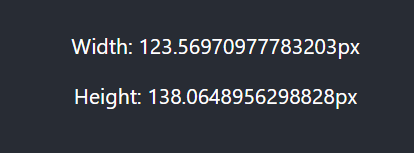
**Output : **
![useLayoutEffect example 1](https://blogkhanwaseem.s3.amazonaws.com/uploads/2023/10/27161458/image-72.png)

In this example, **`useLayoutEffect` **synchronously measures the dimensions of the DOM element, ensuring that the latest dimensions are reflected in the UI.

#### 2. Animations and Transitions

When creating animations or transitions that rely on the precise state of the DOM, **`useLayoutEffect` **is indispensable. It allows you to update the DOM and then immediately animate or transition based on the updated state.

```xml
import React, { useLayoutEffect, useState } from 'react';

function AnimatedElement() {
  const [isVisible, setIsVisible] = useState(false);

  useLayoutEffect(() => {
    setIsVisible(true);
  }, []);

  return (
    <div className={isVisible ? 'animate' : ''}>
      Content to animate
    </div>
  );
}Code language: HTML, XML (xml)
```

**Output : **

![useLayoutEffect example 2](https://blogkhanwaseem.s3.amazonaws.com/uploads/2023/10/27161752/image-73.png)

Here, **`useLayoutEffect` **synchronously triggers the animation by updating the **`isVisible` **state, ensuring a smooth transition.

### Development Issue

While **`useLayoutEffect` **is a powerful tool, it’s essential to use it judiciously and be aware of potential issues:

#### 1. Blocking the Browser

Due to its synchronous execution, `useLayoutEffect` can block the browser, leading to a less responsive user interface. Avoid long-running or heavy computations within the hook.

#### 2. Not Always Necessary

In many cases, **`useEffect` **may be sufficient, and the synchronous behavior of **`useLayoutEffect` **may not be needed. Use it when precise synchronization is essential.

### Conclusion

The **useLayoutEffect **hook in React is a valuable tool for tasks that require precise synchronization between the virtual DOM and the actual DOM. By understanding its core concepts and practical use cases, you can use it effectively to create synchronized, responsive, and visually appealing React applications.

Having **useLayoutEffect **in your toolkit, you can synchronize animations, measurements, and transitions with the most up-to-date DOM state, delivering users a smooth and enjoyable experience. It’s a powerful tool for those situations where precision matters, and it can elevate the quality of your React applications.

### Related posts:

[CSS – Height & Width (Dimension)](https://blog.khanwaseem.com/css-height-width-dimension/)
[CSS – Measurement Units](https://blog.khanwaseem.com/css-measurement-units/)
[HTML – Attributes](https://blog.khanwaseem.com/html-attributes/)
[React Redux](https://blog.khanwaseem.com/react-redux/)

Powered by [YARPP](https://yarpp.com).
