---
title: "Passing Props to a Component"
url: https://khanwaseem.com/blog/course/passing-props-to-a-component
author: "khan Waseem"
published: 2023-10-19
updated: 2023-10-19
topics: ["course", "React Tutorial"]
description: "Learn the power of passing props in React components. Create dynamic and versatile UIs with data, functions, and default values."
---
# Passing Props to a Component
In the world of web development, React has established itself as a powerful library for creating dynamic and interactive user interfaces. Central to ReactJs success is the concept of** “props,”** short for properties. Understanding how to Passing Props to components is fundamental to building flexible and reusable UI elements.
Table of Contents
[Toggle](#)
- [What Are Props?](#what-are-props)
- [Passing Props to a Component](#passing-props-to-a-component)
- [Dynamic Content with Props](#dynamic-content-with-props)
- [Default Props](#default-props)
- [Passing Functions as Props](#passing-functions-as-props)
- [Prop Validation with PropTypes](#prop-validation-with-proptypes)
- [Conclusion](#conclusion)
## What Are Props?
In React,** “props”** are a way to pass data from a parent component to a child component. Think of them as parameters or attributes that you can provide when creating a component. These props are then used by the child component to determine its behavior or appearance.
Props are an essential part of React’s declarative approach to building user interfaces. They enable you to create dynamic and flexible components that can render different content based on the data passed to them.
## Passing Props to a Component
Passing props to a component in React is a straightforward process. Let’s walk through the steps using a simple example.
Suppose you have a parent component called `**App**`, and you want to pass a name to a child component called `Greeting`. Here’s how you can do it:
```xml
// App.js
import React from 'react';
import Greeting from './Greeting';
function App() {
const name = 'John';
return (
);
}
export default App;Code language: HTML, XML (xml)
```
In this example, we’ve defined a constant **`name` **in the **`App` **component and passed it as a prop to the **`Greeting` **component. The syntax for passing props is similar to adding HTML attributes.
Now, let’s take a look at the `Greeting` component:
```xml
// Greeting.js
import React from 'react';
function Greeting(props) {
return
Hello, {props.name}!
;
}
export default Greeting;Code language: HTML, XML (xml)
```
**Output : **
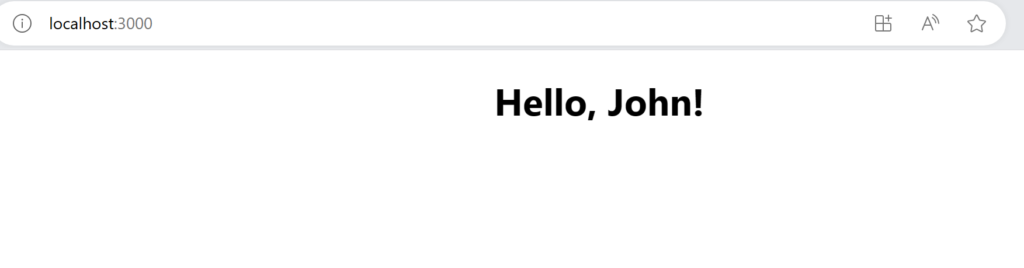
The **`Greeting` **component receives the **`name` **prop through its **`props` **parameter and uses it to display a personalized greeting. The curly braces `**{props.name}**` allow us to access the value of the **`name` **prop within the component.
This basic example demonstrates the concept of passing props from a parent component to a child component. The child component can then use the received props to render content dynamically.
## Dynamic Content with Props
Props allow you to create dynamic content within your React components. You can pass various types of data as props, including strings, numbers, arrays, objects, and even functions. This flexibility enables you to build versatile components that adapt to different use cases.
Here’s an example of a more dynamic component that receives an array of names as props:
```xml
// ListOfNames.js
import React from 'react';
function ListOfNames(props) {
const names = props.names;
return (
{names.map((name, index) => (
{name}
))}
);
}
export default ListOfNames;Code language: HTML, XML (xml)
```
In this component, we’re receiving an array of **names **through the `names` prop and rendering them as a list. The **`map` **function allows us to iterate through the array and generate a list item for each name.
## Default Props
In some cases, you might want to provide default values for props in case they are not passed to a component. React allows you to define default props using the **`defaultProps` **property.
Here’s an example:
```xml
// Greeting.js
import React from 'react';
function Greeting(props) {
return
Hello, {props.name}!
;
}
Greeting.defaultProps = {
name: 'Guest',
};
export default Greeting;Code language: HTML, XML (xml)
```
**Output : **

In this modified **`Greeting` **component, we’ve set a default value of `'**Guest**'` for the **`name` **prop using `**Greeting.defaultProps**`. If the **`name` **prop is not provided when using the **`Greeting` **component, it will default to `**'Guest'**`.
## Passing Functions as Props
Props can also be functions, allowing for interactivity and communication between components. This is especially useful for handling user interactions.
For example, let’s create a button component that receives a function as a prop to define its click behavior:
```xml
// Button.js
import React from 'react';
function Button(props) {
return ;
}
export default Button;Code language: HTML, XML (xml)
```
In this **`Button` **component, we expect two props: **`onClick` **and `**label**`. The **`onClick` **prop is a function that will be called when the button is clicked. The **`label` **prop sets the text displayed on the button.
Now, let’s use this **`Button` **component in a parent component:
```xml
// App.js
import React from 'react';
import Button from './Button';
function App() {
const handleClick = () => {
alert('Button clicked!');
};
return (
);
}
export default App;Code language: HTML, XML (xml)
```
**Output : **
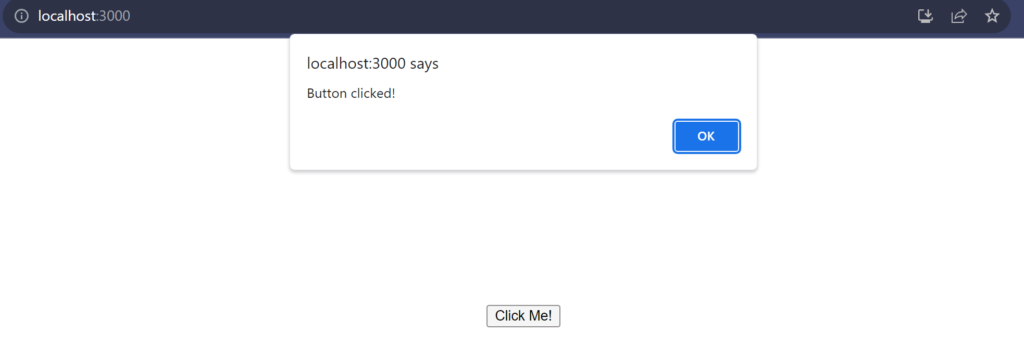
In this **`App` **component, we define a **`handleClick` **function, which displays an alert when the button is clicked. We pass this function as the **`onClick` **prop to the **`Button` **component, along with the **`label` **prop to set the button text.
One of the key benefits of using props in React is component reusability. By passing data and functions as props, you can create highly reusable and versatile components.
For instance, you can use the same **`Button` **component in different parts of your application, customizing its behavior and appearance through props. This reduces code duplication and simplifies maintenance.
## Prop Validation with PropTypes
While React is flexible in terms of the data types you can pass as props, it’s good practice to validate and document the expected props for a component. React provides a package called **`prop-types` **for prop validation.
Here’s how you can use `**prop-types**` to validate the **`name` **prop in our **`Greeting` **component:
```xml
// Greeting.js
import React from 'react';
import PropTypes from 'prop-types';
function Greeting(props) {
return
Hello, {props.name}!
;
}
Greeting.propTypes = {
name: PropTypes.string.isRequired,
};
export default Greeting;Code language: HTML, XML (xml)
```
In this example, we’ve imported `**PropTypes**` from the `prop-types` package and defined `**Greeting.propTypes**` to specify that the `name` prop should be a string and is required.
Using** `prop-types`** enhances code reliability and serves as documentation for other developers who might work with your components.
## Conclusion
Passing props to components is a fundamental concept in React that empowers you to create dynamic and reusable user interfaces. Whether you’re passing data, functions, or default values, props allow you to build versatile components that adapt to various use cases. Understanding how to pass and validate props is essential for becoming proficient in React development.
As you continue your journey in web development with React, props will become second nature, enabling you to craft interactive and modular user interfaces. So go ahead, experiment, and build amazing React applications with confidence, knowing you’ve mastered the art of passing props to your components!
### Related posts:
[React State Management](https://blog.khanwaseem.com/react-state/)
[Importing and Exporting Components](https://blog.khanwaseem.com/importing-and-exporting-components/)
[ReactJS – Installation](https://blog.khanwaseem.com/reactjs-installation/)
[Mastering Conditional Rendering in React](https://blog.khanwaseem.com/mastering-conditional-rendering-in-react/)
Powered by [YARPP](https://yarpp.com).