---
title: "Introduction of HTML"
url: https://khanwaseem.com/blog/course/introduction-of-html
author: "khan Waseem"
published: 2023-09-19
updated: 2023-09-19
topics: ["course", "HTML Tutorial"]
description: "Learn HTML, the foundation of web development. Discover its applications, from building websites and web apps to creating emails and e-learning platforms."
---
# Introduction of HTML
HTML, which stands for HyperText Markup Language, is the foundation of web pages on the internet. It’s like the building blocks that make up websites. Imagine a web page as a digital document or a book. HTML is what defines the structure and content of that document.
Table of Contents
[Toggle](#)
- [Why to Learn HTML?](#why-to-learn-html)[Hello World using HTML.](#hello-world-using-html)
- [Applications of HTML](#applications-of-html)
## Why to Learn HTML?
Learning HTML is valuable for several reasons:
- **Foundation of Web Development**: HTML is the cornerstone of web development. It provides the essential structure for creating web pages. Understanding HTML is like learning the alphabet before you can write a story; it’s the first step in web development.
- **Universal Language**: HTML is a universal language that web browsers understand. When you learn HTML, you gain the ability to create content that can be accessed by people all over the world, regardless of their location or the device they’re using.
- **Control Over Content**: Learning HTML gives you control over how your content is structured and presented on the web. You can format text, add images, create links, and organize information precisely as you want it to appear.
- **Career Opportunities**: Many job roles in the tech industry, such as web developer, web designer, and content creator, require knowledge of HTML. Learning HTML can open up a wide range of career opportunities in the digital world.
- **Creativity and Expression**: HTML allows you to express your creativity by designing and building unique web pages. You can turn your ideas into interactive and visually appealing websites.
- **Accessibility**: HTML includes features for creating accessible web content, making your sites usable by people with disabilities. Learning HTML helps you build inclusive and user-friendly websites.
- **SEO (Search Engine Optimization)**: Understanding HTML is crucial for optimizing your web content for search engines. Properly structured HTML, with the use of meta tags and semantic markup, can improve your website’s search engine ranking and visibility.
- **Independence**: Learning HTML enables you to create and edit web content without relying on specialized software or platforms. You have the freedom to build and maintain your web presence.
- **Communication**: Whether you’re collaborating with web developers or simply discussing web-related concepts, knowing HTML allows you to communicate effectively with others in the field.
- **Continuous Learning**: HTML is a foundational skill, and as you progress in web development, you’ll likely build on this knowledge by learning CSS (Cascading Style Sheets) for styling and JavaScript for interactivity. HTML serves as the starting point for your journey into more advanced web technologies.
In essence, learning HTML is an investment in your digital literacy and opens doors to various career opportunities, creative expression, and effective communication on the web. It’s a valuable skill for anyone interested in the online world, whether as a hobby or a profession.
### Hello World using HTML.
```xml
Hello World
Hello, World!
Code language: HTML, XML (xml)
```
**Output : **
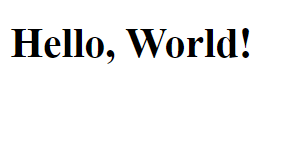
**This HTML code consists of the following parts:**
- ``: This declaration tells the browser that you’re using HTML5, the latest version of HTML.
- ``: This is the root element of your HTML document, enclosing all other elements.
- ``: Inside the head section, you can provide metadata about your webpage, like the title (which appears in the browser tab).
- ``: The title element sets the title of your webpage, which is displayed in the browser’s title bar or tab.
- `<body>`: This is where the visible content of your webpage goes.
- `<h1>`: This is a heading element, and it displays the “Hello, World!” text as a top-level heading.
That’s it! You’ve created a basic HTML document that says “Hello, World!” When you open this file in a web browser, it will render the content as a simple web page. This is often the first step in learning web development and getting familiar with HTML.
### Applications of HTML
HTML, or HyperText Markup Language, has a wide range of applications in the digital world. It serves as the foundation for creating web pages and is an essential tool for various purposes, including:
- **Website Development**: HTML is the primary language used to build websites. It provides the structure and content for web pages, allowing web developers to create and format text, images, links, and other elements.
- **Web Applications**: Many web applications use HTML to create the user interface. HTML, combined with CSS for styling and JavaScript for interactivity, enables the development of dynamic and responsive web applications.
- **Emails**: HTML is used to design and format emails. HTML emails can include images, links, and styled text, making them more visually appealing and informative.
- **E-commerce**: Online stores rely on HTML to display product listings, shopping carts, and checkout pages. HTML is used to create the layout and structure of e-commerce websites.
- **Blogs and Content Management Systems (CMS)**: Blogging platforms and content management systems, such as WordPress, use HTML to format and display blog posts and web content.
- **Online Forums**: HTML is employed to structure and present discussions in online forums and community websites. It helps organize threads, user comments, and multimedia content.
- **E-learning**: HTML is used to create educational websites and e-learning platforms. It allows educators to present course materials, quizzes, videos, and interactive lessons.
- **Intranet Sites**: Organizations use HTML to develop internal websites for sharing information, documents, and company resources among employees.
- **Portfolio Websites**: Artists, designers, and professionals often create portfolio websites using HTML to showcase their work, projects, and skills.
- **News and Media Outlets**: News websites and media outlets use HTML to display articles, images, videos, and interactive features to deliver news and information to readers.
- **Government Websites**: Government agencies use HTML to provide citizens with access to public information, services, and resources online.
- **Personal Websites and Blogs**: Individuals can create personal websites and blogs to share their thoughts, experiences, and hobbies. HTML allows them to customize the appearance and content of their sites.
- **Online Surveys and Forms**: HTML forms are used for online surveys, registrations, and data collection. Users can input information, and HTML handles the form structure and submission.
- **Web-based Applications**: HTML is a fundamental part of web-based applications, including online office suites, project management tools, and collaboration platforms.
- **Mobile Apps**: HTML is sometimes used in the development of hybrid mobile apps, where web technologies are embedded within a native app framework to provide cross-platform compatibility.
In summary, HTML is a versatile and essential language that plays a crucial role in web development, enabling the creation of websites, web applications, and digital content across various industries and sectors. Its flexibility and widespread use make it a foundational skill for anyone interested in the digital landscape.
### Related posts:
[CSS – Table](https://blog.khanwaseem.com/css-table/)
[CSS – Text](https://blog.khanwaseem.com/css-text/)
[HTML – Formatting](https://blog.khanwaseem.com/html-formatting/)
[HTML – Attributes](https://blog.khanwaseem.com/html-attributes/)
Powered by [YARPP](https://yarpp.com).